Notoginseng is sold two ways. Sheng sanqi is the raw root, washed, sun dried and ground. Shu sanqi is the same root steamed before drying, which darkens it and changes its chemistry. Chinese medicine has kept the two apart with one short rule, and two 2026 reviews now describe what the steam does to the compounds inside. This page gives the rule, the chemistry, the form each trial used, and the form buyers pick for each goal.
The Rule: Raw Disperses, Steamed Nourishes
In Chinese medicine the raw root is taken to stop bleeding, break up bruises and move stagnant blood, and the steamed root is taken to build blood and strength after illness, surgery or childbirth. A 2026 review of the processing literature calls notoginseng the textbook example of "different uses for raw and processed products", summed up as "raw for dispersing while processed for tonifying" (Zeng 2026). The raw root's traditional jobs are cardiovascular disease, pain, inflammation, trauma, and internal and external bleeding from injury (Wang 2016). Practitioner references describe the cooked root as weaker at stopping bleeding and better at tonifying weak patients, and note that ordinary households stewed it with pork for recovery (American Dragon; TCM Wiki).
Steaming Converts the Saponins
Raw notoginseng is dominated by five saponins: ginsenosides Rg1, Rb1, Rd and Re, and notoginsenoside R1, which together make up about 90 percent of its saponin content (Zeng 2026b). Heat strips sugar groups from these molecules and removes water from them, and the five convert toward rarer saponins: ginsenosides Rg3, Rg5, Rk1, Rk3 and Rh4 (Zeng 2026). A second 2026 systematic review describes the same shift as high polarity saponins turning into less polar ones through deglycosylation, dehydration and hydroxylation (Wu 2026). A 2011 chemical comparison of air dried and steamed roots across the three Panax species measured that conversion directly and found air dried notoginseng held the most ginsenosides of the three, two to five times more than American and Asian ginseng (Sun 2011).
The second change is to dencichine, the compound tied to the root's clotting action. Heat based processing lowers it, which is why the raw root is the form kept for bleeding (Zeng 2026). Both reviews land in the same place: raw root is the blood activating and bleeding stopping form, and steamed root shows more blood nourishing, antioxidant and immune activity, measured so far in laboratory and animal work (Wu 2026). The first review also notes that there is no quality standard for processed notoginseng and that steaming methods vary from maker to maker (Zeng 2026).
The Nourishing Claim Has an Animal Study Behind It
A 2026 study of steamed notoginseng saponins used an animal model of chemotherapy anaemia, zebrafish with labelled red blood cells and a human cell line (Xu 2026). The steamed saponins raised red blood cell production, and Rk3 and Rh4, two of the rare saponins that steaming creates, and a third saponin, F1, each did so on their own in the zebrafish. No people took part. The study is the closest modern test of the tradition that steamed root builds blood, and it is an animal and laboratory result.
No Human Trial Compares Raw with Steamed
Almost every human trial of notoginseng used a standardised saponin extract, sold as Xuesaitong or Xueshuantong, as a capsule or as a hospital injection. Those extracts carry the raw root's Rg1, Rb1, Rd, Re and R1 profile (Zeng 2026b). The 2023 stroke trial of 2,966 people used 120 mg of the saponin capsule twice a day for 3 months (Wu 2023), and the 2002 trial of 60 women after childbirth used the same capsule for 7 days (Liu 2002). The trials that gave the plant itself in grams, 1,350 mg a day for endurance (Liang 2005) and 3 grams a day for blood sugar (Liang 2012), do not say in their abstracts whether the root was raw or steamed. A 2024 review of 31 trials in 2,076 people after hip fracture surgery ranked sanqi powder among the top three Chinese herbal options for holding haemoglobin up, and that is the closest a trial record comes to plain powder (Wu 2024). No human trial has compared raw root with steamed root for any outcome.
Which Form People Buy for Which Goal
Buyers follow the rule. Raw powder is the jar kept for bruises, nosebleeds, heavy periods and recovery from a knock, and it is the form people with circulation concerns take day to day. The trials behind those uses are in notoginseng for bruises and bleeding and notoginseng for circulation.
Steamed powder or whole steamed root is bought after surgery, childbirth or a long illness, usually on a practitioner's advice, and often cooked into chicken or pork soup rather than swallowed as powder. The saponin capsule that the heart and stroke trials used is a third form, neither raw powder nor steamed powder, and its results are in notoginseng for heart health.
How to Tell Them Apart
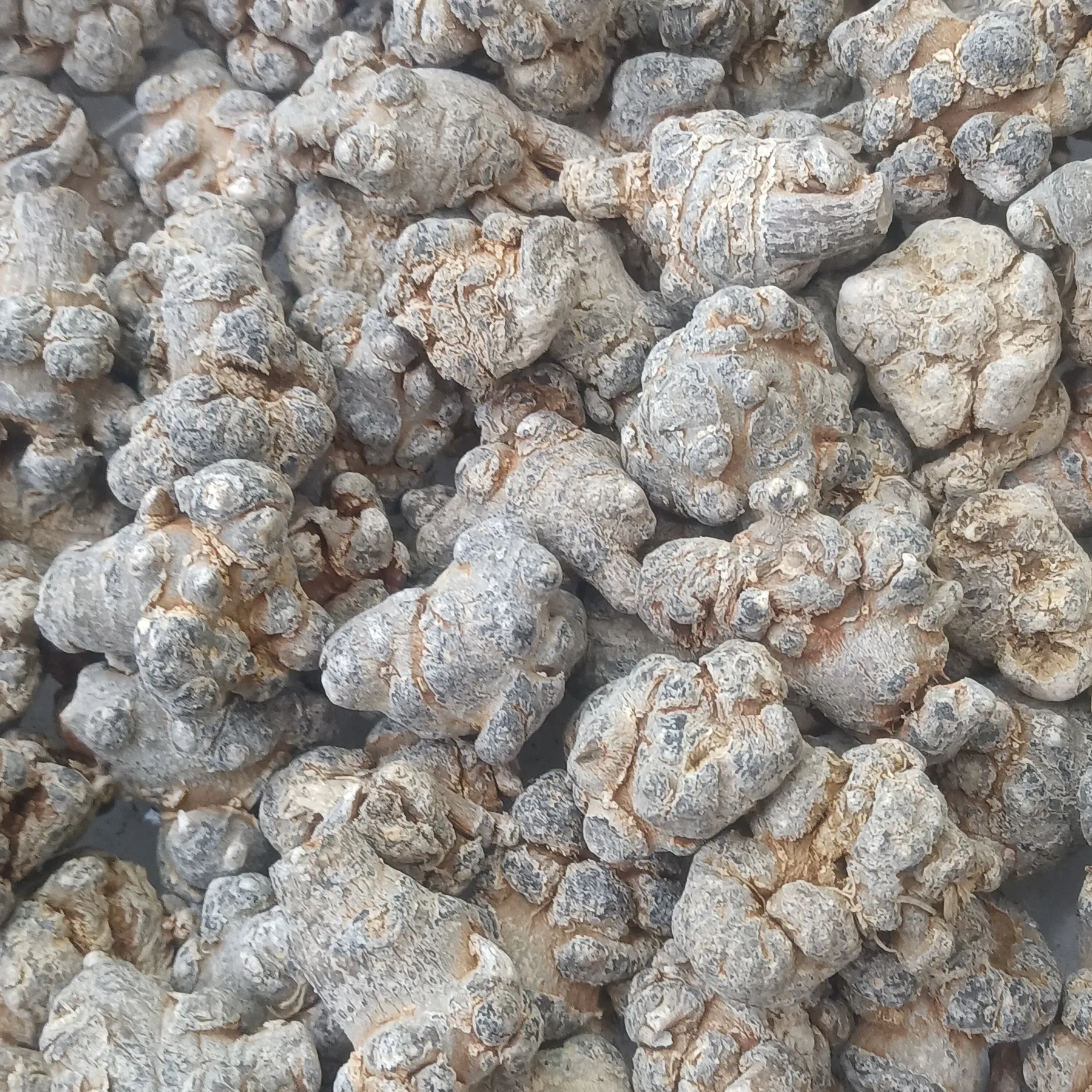
Raw root is heavy and hard, with a greyish green or yellowish green cut surface and a taste that is bitter first and then sweet (TCM Wiki). Steamed root is sold as shu sanqi, and the chemistry literature calls it red notoginseng, the same naming used for steamed Korean ginseng (Sun 2011). Ask the seller whether a powder is sheng or shu, since the label decides the job. Grades, origin and substitutes are in how to choose notoginseng, and amounts by form are in notoginseng dosage.
What Users Report
People who keep raw powder at home often report that it is their bruise and nosebleed remedy, and many say bruises fade faster with it. People who take the steamed root describe it as a recovery tonic after surgery or childbirth, usually in soup, and report feeling stronger over weeks rather than days. Many keep both jars and do not swap one for the other. These are reports, not study findings.
Safety Notes
Both forms come from the same root, and the raw form in particular acts on bleeding and platelets. Talk with your doctor before taking notoginseng if you take warfarin, aspirin, clopidogrel or any blood thinner. Stop it before surgery. Avoid it in pregnancy and breastfeeding, where there are no trials. The trial record on side effects is in notoginseng side effects.
The other two Panax species, and which one fits which goal, are in the three Panax species.
References
- Zeng X et al. 2026. Processing-driven chemical transformations and pharmacological shifts in Panax notoginseng. J Ethnopharmacol.
- Wang T et al. 2016. Traditional uses, botany, phytochemistry, pharmacology and toxicology of Panax notoginseng (Burk.) F.H. Chen: A review. J Ethnopharmacol.
- Zeng X et al. 2026. Panax notoginseng saponins against ischemic stroke: From molecule to clinic. J Ethnopharmacol.
- Wu Q et al. 2026. From raw to steamed Panax notoginseng: A systematic review of saponin transformations and their functional consequences. Pak J Pharm Sci.
- Sun S et al. 2011. Red notoginseng: higher ginsenoside content and stronger anticancer potential than Asian and American ginseng. Food Chem.
- Xu C et al. 2026. Steamed Panax notoginseng saponins ameliorate cyclophosphamide-induced anemia by promoting erythroid progenitor proliferation via the cAMP/PI3K/AKT/cGMP pathway. J Ethnopharmacol.
- Wu L et al. 2023. Efficacy and Safety of Panax notoginseng Saponins in the Treatment of Adults With Ischemic Stroke in China: A Randomized Clinical Trial. JAMA Netw Open.
- Liu DY et al. 2002. Clinical observation on treatment of postpartum hemorrhage by xuesaitong soft capsule. Zhongguo Zhong Xi Yi Jie He Za Zhi.
- Liang MT et al. 2005. Panax notoginseng supplementation enhances physical performance during endurance exercise. J Strength Cond Res.
- Liang MTC et al. 2012. Effects of Panax notoginseng (Chinese ginseng) and acute exercise on postprandial glycemia in non-diabetic adults. J Complement Integr Med.
- Wu X et al. 2024. Identifying an effective Chinese herbal medicine for reducing postoperative hidden bleeding and stabilizing blood volume following intertrochanteric femur fracture: a Bayesian network meta-analysis of randomized controlled trials. J Orthop Surg Res.
Nothing here is medical advice. If you take prescription medication, talk with your doctor before adding notoginseng.